
A debate has erupted online over care gaps when migrant domestic caregivers in Taiwan become pregnant and take time off. The controversy has even fueled discrimination against pregnant migrant workers.
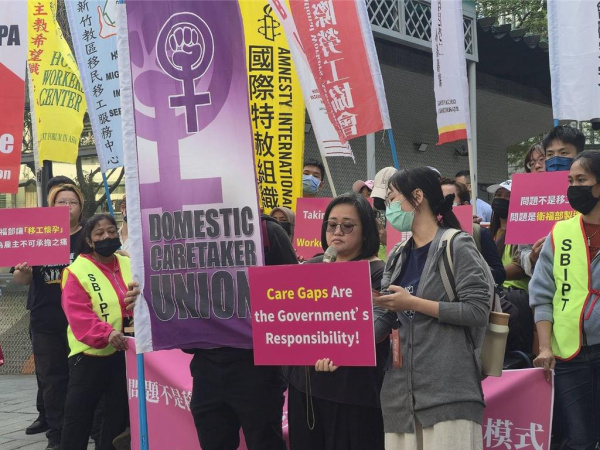
October 27, several civil society groups protested outside the Ministry of Health and Welfare (MOHW), arguing that migrant workers getting pregnant is not the problem. Taking leave is a basic labor right, and the government—not migrant workers—is responsible for addressing gaps in care.
The groups said the Long-Term Care 3.0 program is not practical enough, while the Ministry of Labor’s multiple companionship care services require families to pay entirely out of pocket, making them accessible only to those who can afford them. They called on the government to immediately begin planning an institutional employment system for migrant domestic workers, so that substitute caregivers can step in whenever workers take leave.
Disability Support Must Never Stop! Migrant Workers Need an Institutional Employment System!
The Taoyuan City Domestic Care Workers’ Union, Taiwan Alliance to Promote Self-Help for People with Disabilities, Awakening Foundation, and Taiwan International Workers’ Association (TIWA) took to the streets today.
They said the issue of care gaps caused by migrant workers’ pregnancies has been deliberately framed as a conflict between migrant workers’ right to take time off and families’ long-term care needs. This wrongly shifts the government's responsibility away from providing public care services and toward restricting migrant workers’ labor rights.
Pregnancy and childbirth are not the only situations that create difficulties for employers. Regular days off, public holidays, sick leave, serious illness, workplace accidents, and even trips home to visit family can all leave gaps in care. When employers’ expectations of uninterrupted, round-the-clock care cannot be met, some direct their frustration toward migrant domestic workers and call for their labor protections to be rolled back.
Caregivers Are Human Too
“Caregivers are human too,” said Bonang, a representative of the Domestic Care Workers’ Union. Migrant domestic workers should never be expected to work seven days a week, 24 hours a day, without adequate rest. Caring for older people and people with disabilities is important, but caregivers are human beings who also need sufficient sleep, regular days off, and healthy working conditions.
Bonang stressed that pregnancy should never be used as an excuse to undermine the rights and dignity of female migrant workers.
“Instead of pushing discriminatory measures, we should address the structural problems in the care system and ensure that all workers are treated fairly and receive appropriate support.”
Government Has Shifted the Burden of Care to Families
Lee Ying-hsueh, director of the Policy Department at the Awakening Foundation, said that amid the recent controversy over migrant workers’ pregnancies, some online commentators have suggested requiring migrant workers to undergo pregnancy tests and virus screenings before entering Taiwan.
“Discrimination should have no place in our society, yet the Ministry of Health and Welfare has simply stood by and watched.”
Lee said the government has long shifted responsibility for caring for people with disabilities and those who need long-term care onto individual families, without providing sufficient public support. At the same time, migrant workers are not given adequate labor protections, leaving female family members to bear the burden when no one else steps in.
NGOs Call for an Institutional Employment System
The groups jointly called on the Ministry of Health and Welfare to work with the Ministry of Labor to design and develop a wider range of companionship and care services.
Alongside expanding the care workforce and support services for people with disabilities, the government should immediately begin planning an institutional employment system for migrant domestic workers. This would allow substitute caregivers to take over when workers are on leave and establish an emergency backup system to prevent disruptions in care.
Wu Hsi-wen, deputy director-general of the Department of Long-Term Care at the Ministry of Health and Welfare, said that since September last year, families employing migrant workers have been eligible to use community-based care services, such as adult day care centers, regardless of whether their migrant workers are currently taking leave.
She encouraged families employing migrant workers to also apply for an assessment of their family member's long-term care needs and disability level. This would allow them to access additional services when needed, including transportation and home accessibility improvements.
Wu noted that families employing migrant workers may also need these long-term care services.
[China Times | By Lin Chou-yi] October 27, 2026, 2:32 PM
[Photo by Lin Chou-yi]