
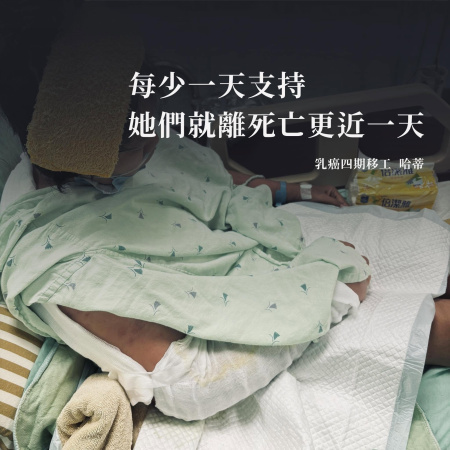
When Hati first arrived at the shelter, the skin on her entire right arm, right breast, and back was blackened and ulcerated. Her clothes were soaked with pus and blood, and a strong smell of blood filled the air. She kept crying out, “It hurts so much. It hurts, it hurts, it hurts…”
The shelter team immediately cleaned her wounds and changed her into clean clothes. What followed was a race against time: arranging medical care, finding a hospital bed, and getting her admitted for emergency treatment. The hospital quickly arranged for wound debridement and chemotherapy.
“How could you wait until your skin was rotting before seeing a doctor? Didn’t you feel a lump in your breast?”
These are the first questions many people ask when they see the severity of her condition.
Lying in her hospital bed, Hati was drenched in cold sweat, her face filled with regret.
“I never thought it would get this bad… I have to tell my employer if I want to see a doctor, and then I have to wait for them to make arrangements. If it doesn’t hurt too much, I don’t say anything.”
Hati, 45, is a single mother of two from East Java, Indonesia. For six years, she cared for an elderly couple in Changhua, with almost no days off. She had never even left the small town where she worked. She had grown so accustomed to enduring hardship that she ignored the vague discomfort in her chest.
It wasn’t until May, when a tearing pain struck her right breast, that she finally asked her employer to take her to the hospital.
During the two weeks she waited for her diagnosis, the ulcers on her skin spread rapidly from her breast. Her entire right arm swelled, pus and blood seeped from her wounds, and the damage spread to her back. At night, the pain was so severe that she could not sleep.
After being diagnosed with stage IV breast cancer, Hati reached out to the SPA Indonesian Migrant Worker Shelter for help. That was when the emergency assistance described at the beginning of this story began, as the team urgently arranged accommodation and medical care for her.
Hati’s prognosis is poor. After her condition stabilized somewhat last month, and with her consent, we worked with the Indonesian Economic and Trade Office to arrange a medical evacuation flight to take her home, where she could reunite with her son.
We have asked ourselves countless times: If her cancer had been detected earlier, could things have turned out differently? Would she have been spared from reaching this point?
But now, all we can do is our best to help her return home while she still has the strength to travel—to be with the family who loves her and spend the time she has left with them, without regrets.
⸻
Migrant workers in Taiwan often struggle to access medical care because of language barriers, unequal access to information, and interference from their employers. Hati’s story is not an isolated case, nor will it be the last.
SPA has long provided shelter and medical assistance to migrant workers who fall ill or suffer injuries. Caring for migrant workers with cancer, in particular, places an enormous burden on our medical expenses and staff resources.
Even when funding has been tight, we have repeatedly pushed ourselves to keep going, rescuing migrant workers who have nowhere else to turn. We do so because we firmly believe that no one’s life should ever be abandoned.