
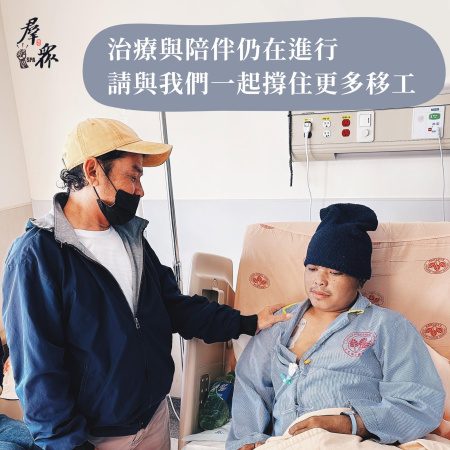
“Take good care of yourself. I’ll be waiting for you at home.”
Toni’s father, usually a quiet man, repeated these words to his son again and again that morning. His caregiver visa had expired and could not be extended—he would have to return to Indonesia the next day.
In early 2025, SPA took in Toni, an Indonesian fisherman diagnosed with acute leukemia. At the time, his condition was critical. Without an urgent stem cell transplant, his chances of survival were extremely slim. With the support of many kind donors, we were able to raise enough funds for the transplant and the long-term treatment that would follow. After discussing with Toni’s family, his father came to Taiwan to care for him and face the long, difficult recovery together.
For the past eight months, Toni and his father have practically lived in the hospital. It was Toni’s father’s first time abroad, and everything in Taiwan felt unfamiliar. Afraid of accidentally eating pork, he did not dare try food beyond the hospital meals. Unable to speak the language, he was also hesitant to go out to buy food. Later, Indonesian caregivers in the hospital learned about their situation and added him to a chat group. With the help of fellow Indonesians, he gradually learned how to use the hospital’s laundry machines and began venturing out to nearby Indonesian eateries for familiar meals.
Toni’s father shared that before coming to Taiwan, he had no idea how many Indonesians worked in hospitals caring for elderly patients. Among them was a migrant mother who had once stayed at our shelter while pregnant. After learning that Toni was in the same hospital as the elderly person she cared for, she brought fruit to visit them, offering help during one of their most difficult times. After the transplant, Toni suffered severe rejection symptoms—his throat bled, eating became extremely painful, and he grew very weak. One Indonesian caregiver even cooked a pot of Indonesian vegetable curry with rice cakes and brought it to his room. It was the first time Toni regained his appetite. These small acts of care held up the father and son’s daily life in the hospital.
Toni’s father has expressed his gratitude to us many times. He is deeply thankful to the medical staff for their careful and patient care before and after the surgery, and to every donor who supported Toni’s chemotherapy and transplant—those who reached out a hand at a critical moment.
We have now arranged long-term caregiving support for Toni. Due to ongoing rejection symptoms, he still requires extended hospitalization for observation and treatment. However, his condition has improved significantly—he is almost unrecognizable compared to how weak he was at the beginning of the year.
Still, this journey of treatment and care remains a long road that requires sustained resources.
We believe there are many migrant workers in Taiwan like Toni—working long hours under physically demanding conditions, often ignoring warning signs from their bodies until they collapse, endure unbearable pain, or are rushed to the hospital, only to discover a serious illness.
When illness strikes, they must face not only physical suffering, but also language barriers and a lack of caregiving and support resources. What we can do is this: when the system fails to catch them in time, we catch them first.
We invite you to join us with a monthly donation. Together, we can support more injured and ill migrant workers. Your ongoing support will go toward emergency medical care, follow-up treatment, and caregiving arrangements—so that when they are at their most vulnerable, they are not forced to abandon treatment.