
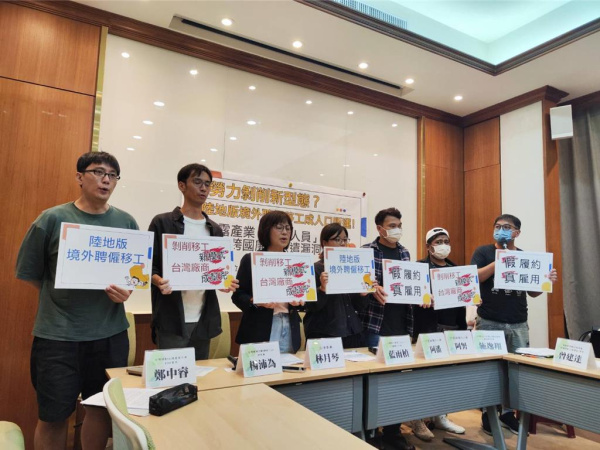
Singapore-based multinational company Sheffield Green Energy has been applying to Taiwan’s Ministry of Labor to bring in large numbers of foreign “contract workers” under the category of white-collar professionals and technical workers through its Taiwan subsidiary.
However, Indonesian workers have come forward alleging that they were promised monthly salaries of NT$48,000 before coming to Taiwan to perform skilled work such as pipeline installation. After arriving, they were allegedly pressured to sign new contracts that reduced their pay to just NT$100 an hour. Their jobs were also changed to general labor, including cleaning, moving rocks and carrying cement.
Civic groups and lawmakers have questioned whether the case represents a new form of cross-border labor outsourcing designed to exploit cheap foreign labor. Taiwan’s National Immigration Agency said it has launched an investigation under the Human Trafficking Prevention Act.
Workers Say They Were Forced to Sign New Contracts
The case has raised concerns over what labor advocates describe as a new form of migrant-worker exploitation. S
heffield Green Energy, a Singapore-based multinational group, has used its Taiwan subsidiary to apply to the Ministry of Labor for foreign workers to enter Taiwan as “contract workers” under the Employment Service Act.
Before coming to Taiwan, some Indonesian technical workers signed contracts promising monthly salaries of NT$48,596 and skilled jobs such as pipeline installation. But after arriving in Taiwan, they were allegedly asked to sign new contracts that cut their wages to just NT$100 an hour. Their work was also changed to tasks such as grinding, cleaning, tying pipes, moving rocks and carrying cement.
The workers feared that refusing to sign could lead to termination, loss of their residency status and deportation. As a result, they felt they had little choice but to sign the new contracts and accept the lower-paid work.
One Indonesian contract worker, Anu, said:
“I’m willing to come forward and become a victim. That’s okay. But I hope no one else will have to go through what I went through. I hope the company will give me fair compensation for the work I have done during this period.”
Lan Yu-chen, a worker with MENT, said:
“Their monthly salary went from more than NT$48,000 to just 56,270 Indonesian rupiah an hour. To put that into Taiwanese dollars, that’s only NT$100 an hour—almost exactly NT$100. And they don’t have labor or health insurance.”
Concerns Over Forced Labor and Human Trafficking
The workers reportedly do not have labor or national health insurance, leaving them particularly vulnerable if they suffer serious workplace injuries. Labor advocates have questioned whether companies are using the “contract worker” system to circumvent Taiwan’s minimum wage and labor protections.
Civic groups accuse the company of practices that could constitute forced labor and human trafficking, and warn that the system could become a new model for cross-border outsourcing of cheap labor.
Lawmakers say there are currently around 210 contract workers under the system. They are calling on the National Immigration Agency to launch a dedicated investigation into whether the system is being used for large-scale “fake contracting, real labor dispatch”—bringing workers into Taiwan under the guise of professional contracts while actually assigning them to general labor jobs.
Fang Yi-fan, a section chief with the Kaohsiung City Special Operations Brigade of the National Immigration Agency’s Southern Affairs Corps, said:
“Regarding the investigation into potential victims of human trafficking, we hope to protect the rights of all the foreign workers mentioned today while they are working in Taiwan.”
Tseng Chien-ta, a senior specialist with the Workforce Development Agency’s Cross-Border Workforce Management Division, said:
“In the future, when reviewing these contract-worker cases, if the actual work does not meet the requirements for professional or technical work, we will strengthen our screening and review procedures.”
Government Promises to Review the System
Lawmakers have called for the government to establish clearer mechanisms for complaints, legal remedies and regulatory oversight, citing potential loopholes in the contract-worker system. The National Immigration Agency said that after receiving the allegations, it launched an investigation under the Human Trafficking Prevention Act. The Workforce Development Agency also said it would review the system and strengthen protections for foreign workers.
[PTS / Huang Tzu-chieh and Chang Min-ju]2026/8/21 16:20
[Photo by CTN Reporter Lin Liangqi]