
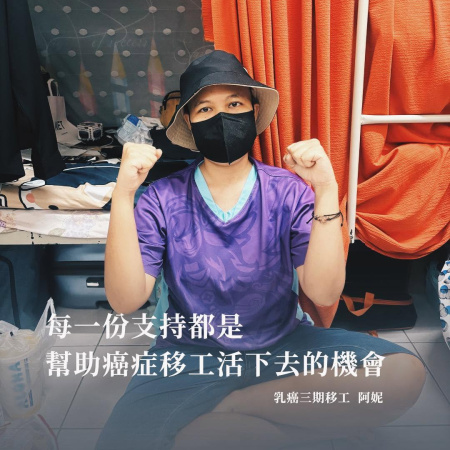
What should a 33-year-old’s life look like?
Ani has no marriage, no children—and now, she has lost her health, too.
Ani is from Subang, West Java, Indonesia. She grew up in a single-parent family, raised by her grandmother and aunt at different times. When she talks about her mother, she cannot hide her concern:
“My mother works in Jakarta and has always ended up with men who are abusive. I want to take care of her, so she can return to our hometown and live with our family.”
Grateful for the care she received from her mother and relatives growing up, Ani always felt that she owed them something in return. As she grew older, supporting her family became her responsibility.
In 2017, Ani came to Taiwan to work. She earned just NT$23,000 a month, but she consistently sent NT$16,000 home every month. That money supported her mother’s living expenses, her older brother’s children’s school fees, and the aunt who had helped raise her.
Ani rarely spent money on herself.
She never cared much about makeup or dressing up, and she had never really cared about her appearance. During her years in Taiwan, she never traveled. She always felt that going out meant spending money, so she usually stayed in the city where she worked even on her days off.
Her only major expense over the years came this January, when she spent NT$200,000 of her hard-earned savings to buy a piece of land back home. She hoped to eventually start a small business and build a life of her own. Ani’s story reflects the lives of many migrant workers. They spend their precious youth and health working as hard as they can in Taiwan, afraid to stop because the money they earn is not just for themselves—it supports their entire family.
This January, Ani noticed a small lump in her breast. But she did not seek medical attention right away.
She was afraid she might be overreacting. If the examination turned out to be nothing, she worried that she would only cause trouble for her employer and broker.
By April, however, the lump had grown rapidly. The skin under her arm had become red, swollen and raised. She finally had no choice but to ask her employer to take her to the hospital.
She was diagnosed with stage 3 breast cancer.
Ani never imagined that after eight years of working in Taiwan, finally helping her family get settled and beginning to save a little money for herself, she would become seriously ill. But she quickly pulled herself together and began chemotherapy every three weeks. After shaving her head, she smiled and said cheerfully, “My family knows.”
Her family wanted her to return to Indonesia. But Ani knew that the quality of medical care in Taiwan could give her a better chance of recovery. She chose to stay and fight for another chance at her life. Thankfully, Ani has not had to face her treatment journey alone.
We provide her with free accommodation and meals, accompany her to medical appointments, and help with interpretation so she can focus on completing her treatment. But these are only the most basic forms of support. Chemotherapy has left her extremely weak. She still needs nutritional supplements, transportation to and from the hospital, long-term care and emotional support. All of these require continued support from people who are willing to help.
Migrant workers like Ani who are fighting cancer still have a chance to recover. Her chemotherapy is already showing significant results, and the tumor has visibly shrunk. If she can complete her treatment in Taiwan, Ani will have the chance to regain her health, return to work, and keep moving forward with the life and dreams she has not yet had the chance to pursue.
If you have read this far, we invite you to stand with Ani through the hardest part of her journey. Every act of care can give a migrant worker fighting cancer in Taiwan another chance to live.