
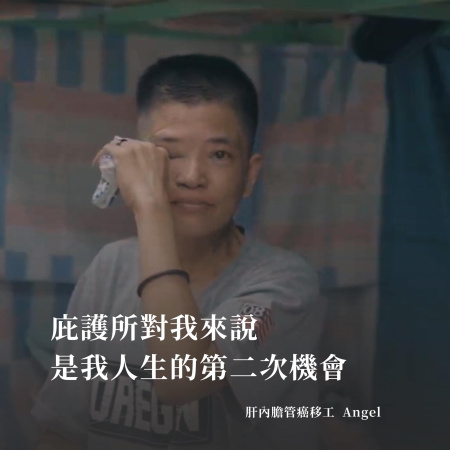
For the past six years in Taiwan, Angel—a Filipino migrant worker—used her hands to lift and care for elderly people, one after another.
Now, she’s the one who has fallen.
Angel is 43, a single mother who lost her parents at a young age. As the family’s main breadwinner, she carries far more than just her own life—she pays for her son’s college education while also supporting her unemployed siblings.
When she talks about her child, her eyes soften. Her son is her greatest pride—and the reason she keeps going.
As a live-in caregiver, Angel looked after a bedridden elderly person under conditions most people could hardly imagine.
Her day started at 7 a.m. and didn’t ease until 10 p.m. Even at night, she never had uninterrupted sleep. Every 30 minutes, she had to get up—to manage catheter care, reposition the patient, and assist with movement.
Over time, the constant physical strain and sleep deprivation pushed her body to its limits.
She went from 64 kg to 52 kg in just a few months—a loss of 12 kilograms.
When she finally collapsed and went to the hospital with a friend, she received devastating news:
Stage IV intrahepatic cholangiocarcinoma.
After her diagnosis, her agency told her to return to the Philippines.
But Angel knew the reality—without money, a serious illness there can be a death sentence.
At her most desperate moment, a friend brought her to a shelter.
“The shelter is a second chance at life for me. I thought I was going to die like that. But here, I feel happy, because people help each other. If I had gone back to the Philippines, I might already be dead. Because if you don’t have money there, you can’t survive.”
Angel is now undergoing intensive chemotherapy at Chang Gung Memorial Hospital.
We support her daily needs—housing, meals, transportation to the hospital, and interpretation services. Watching her endure treatment, regain weight, and finally have her catheter removed has been a source of relief and hope for all of us.
In the shelter, many migrant workers facing illness share a similar habit.
They often say:
“I leave everything to God.” “Thank God for His plan.”
We understand that their recovery depends on professional medical care—but faith gives them something medicine cannot: the strength to keep going.
Because no one chooses to fall ill in a foreign land. And no one is ever ready to face the fear of death at such a young age.
Without some way to make meaning of suffering, many simply wouldn’t be able to endure it.
When Angel, weak but smiling, says “thank you” to Taiwan and to the shelter, it often breaks our hearts.
Because we know there are still voices in society questioning whether migrant workers should have access to Taiwan’s National Health Insurance.
But here’s the truth:
No one wants to get sick.
And no one wants to face illness alone, thousands of kilometers away from home.
Angel gave six years of her youth to Taiwan—caring for our elderly, supporting our families. As a contributor to the healthcare system, she has every right to stay and receive treatment when she falls ill.
But treating stage IV cancer is a long and difficult journey.
Some medical expenses are not covered by insurance. Nutritional support, daily care needs during chemotherapy—these costs are already beyond what the shelter can sustain long-term.
We are doing everything we can to give her a place to stay. But for her to continue treatment and have a real chance to survive— she needs more support.